
Criminal Cases in the Matagorda County Courts
Matagorda County criminal court cases do not all begin at one counter. The 23rd and 130th Judicial District Courts exercise felony jurisdiction, and the District Clerk keeps those district-level criminal files. An accepted felony normally goes to a grand jury. If at least nine jurors return a true bill, the indictment is filed in District Court. The Matagorda County Court at Law handles Class A and Class B misdemeanors within its statutory jurisdiction, with county-level records obtained through the County Clerk. That split makes the alleged offense level a useful first clue.
Fine-only misdemeanors and municipal ordinance matters can stay with a justice or municipal court. Those records are not assured to appear in a District Clerk search. A warrant issued by one of those lower courts also remains tied to that court's file. The safest method is to identify the charging court before ordering a document. When the offense level is uncertain, ask which clerk holds the cause rather than assuming the courthouse has a single criminal index.
Matagorda County Criminal Case Court Split
Three charging papers help explain the Matagorda County court split. A complaint is a sworn allegation that may support a charge or warrant. An information is the charging instrument commonly used after a prosecutor accepts a misdemeanor. An indictment is the grand jury's true bill for a felony. The arresting officer's initial charge is not always the charge that appears in any of these filed papers.
Start felony requests with the Matagorda County District Clerk at 1700 7th Street, Room 307, Bay City, TX 77414-5092. The office lists 979-244-7621 and dclerk@co.matagorda.tx.us, with counter hours Monday through Friday, 8:00 a.m. to 5:00 p.m., closed from noon to 1:00 p.m. For county-level misdemeanor files, use the County Clerk. Municipal and justice court matters require contact with the issuing court.
How to Search Case Records
A sound Matagorda County criminal case search starts with the court level and then moves to the custodian. Public clerk records do not require a Texas Public Information Act request merely to be reviewed. The county's public-information policy directs readers to the clerk and online services for court records. Use a public-information request for other county records, not as a substitute for the clerk's judicial-record process.
- Classify the matter as a likely felony, Class A or B misdemeanor, or fine-only municipal or justice court case.
- Gather the full name, approximate filing date, court number, cause number, and case style when known.
- Check the proper clerk or court index, then compare similar names carefully.
- Read the docket and filed charging instrument before treating an arrest charge as final.
- Request the exact pleading, order, judgment, or certified copy from the custodian.
The District Clerk's Record(s) Request form reveals the local search fields. Their required status is not stated on the form.
| Field Label | Type | Required | Notes |
|---|---|---|---|
| Cause No. | Text | Unspecified | Local cause or case number |
| Court No. | Text | Unspecified | Identifies the district court |
| Case Style | Text | Unspecified | Caption or party name |
| Requested Document | Text | Unspecified | Three document lines per form |
| Certified | Checkbox | Unspecified | Choose yes or no for each item |
Matagorda County Criminal Cases Beyond re:SearchTX
re:SearchTX is the statewide eFileTexas-linked court access platform. A free account is required. Its tools can search cases, filings, text in documents, and hearings, then apply filters or save a search. Yet the Texas Judicial Council reported in 2024 that the portal's large document collection excluded criminal case records. Coverage also varies by participating court, account, and user role. A blank result is therefore not proof that Matagorda County has no criminal case.
The official manifest captures the re:SearchTX login and access point used for statewide court research.
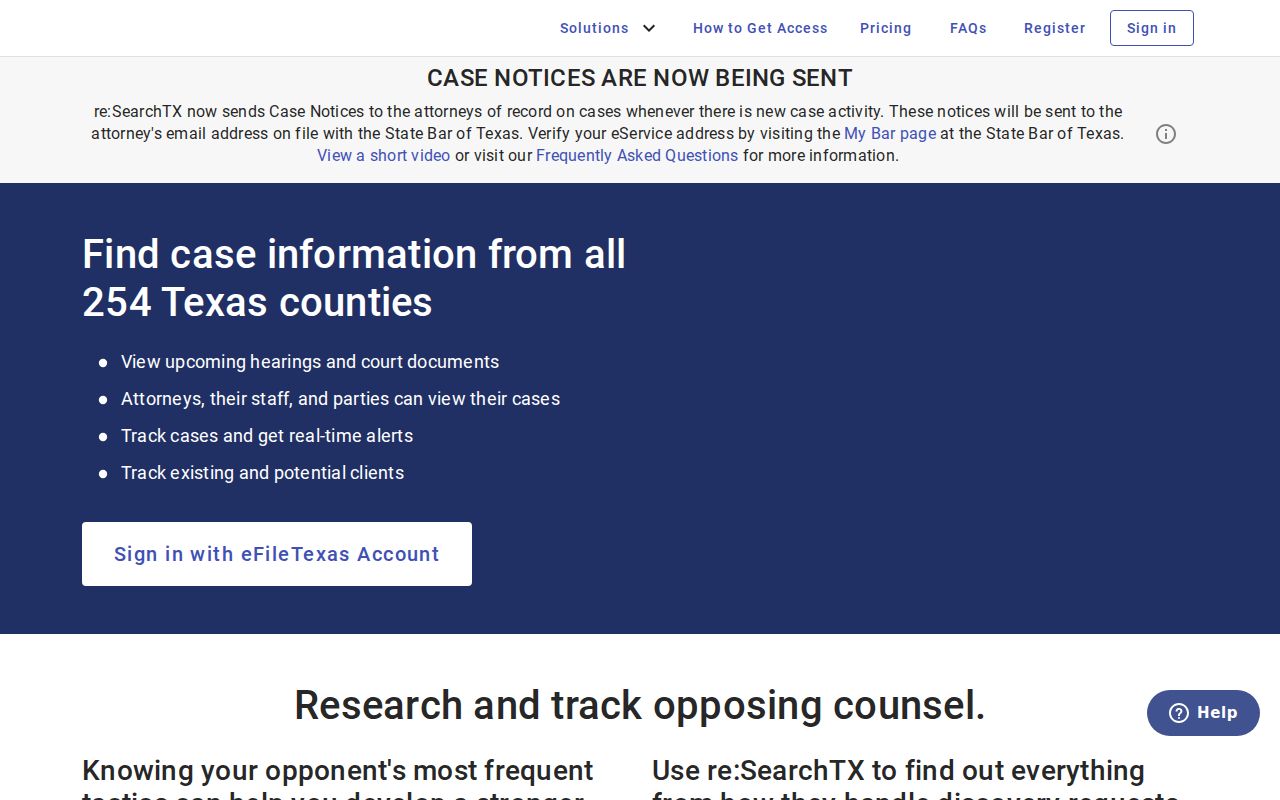
The login image underscores the key limit: account access is only a starting point, while the local clerk remains the dependable criminal-file source.
What the Case File Shows
A Matagorda County criminal case file records the prosecution as it actually reached court. It may include the complaint, information or indictment, motions, bond orders, settings, plea papers, verdict, judgment, and later notices. The docket is the dated index of those events. A document image may not be available for every entry, and restricted material can be withheld even when the basic case is public.
| Case Number & Court | Identifies the cause and the court responsible for the file. |
|---|---|
| Charging Document | Shows the prosecuted charge through a complaint, information, or indictment. |
| Docket Entries | Lists filings, settings, rulings, and other case events by date. |
| Hearing Dates | Shows scheduled appearances and may record resets or completed hearings. |
| Disposition & Judgment | States how the charge ended and records the court's formal judgment. |
| Sentence & Conditions | May list confinement, fine, costs, restitution, or community supervision. |
A booking charge can be declined, reduced, enhanced, amended, dismissed, or replaced. For that reason, the filed charging instrument and final judgment answer different questions than a jail entry. The broader Matagorda County arrest history route is useful for the custody event, while the clerk file controls the court outcome.
Matagorda County Criminal Case Copy Choices
The District Clerk's Record(s) Request form supports paper, electronic, and certified copies. It asks for the cause number, court number, case style, exact document, number of copies, requester contact details, and whether certification is needed. Submit it to dclerk@co.matagorda.tx.us, fax it to 979-244-7624, or use the address printed for Room 307. The form says to allow 24 to 48 hours and to call when copies are needed sooner.
| District Clerk Product | Published Fee |
|---|---|
| Paper copy | $1.00 per page |
| Electronic copy | $0.10 per page, $1.00 minimum |
| Paper converted to electronic | $1.00 per page |
| Certification | $5.00 per document |
| Research or search | $5.00 per search |
Certification authenticates a clerk copy. It does not add facts to the record. A plain electronic copy may be enough for personal review, while a certified judgment or dismissal should come from the clerk rather than a portal screenshot.
Stages of a Criminal Case
After an arrest, a magistrate explains the accusation and rights, addresses counsel, and considers bail. Law enforcement then sends its work to the Matagorda County District Attorney. Prosecutors may seek more investigation, reject the matter, file an information for an accepted misdemeanor, or present an accepted felony to the grand jury. An indictment moves a felony into District Court for pretrial work, plea talks, dismissal, or trial. If guilt is established, the court imposes sentence. An appeal reviews the trial record rather than hearing the case anew.
Case flow: Charges Filed › Arraignment › Pretrial › Plea or Trial › Disposition › Sentencing
This sequence explains why records can lag. A jail entry may exist before any clerk file, while the final judgment appears only after the case reaches a disposition.
Reading Matagorda County Criminal Case Outcomes
Outcome terms should be read with care. A conviction means guilt was adjudicated after a plea or verdict. Deferred adjudication postpones a finding of guilt while the person completes community supervision, but it is not an acquittal or expunction. A dismissal ends the charge without a conviction on that count. An acquittal means the tried charge did not result in guilt. A no-bill means the grand jury did not return an indictment on the matter presented.
- Pending
- The prosecution has not reached a final result.
- Disposed
- A final trial-court order or judgment ended the case, though later filings may occur.
- Capias
- Court process directing that a person be taken into custody.
- Community supervision
- Texas court-ordered supervision commonly called probation.
Read the judgment alongside the docket. A status label alone may not show which count was dismissed, which count supported the sentence, or whether an appeal or later order changed access.
Access & Restrictions
Texas court records are generally open, but access has firm limits. Juvenile files, protected victim details, Social Security numbers, financial identifiers, sealed documents, expunged material, and information covered by an order of nondisclosure may not appear in an ordinary public view. Online displays can also redact more than the paper file available under the clerk's rules. The Texas Judicial Branch rules and standards provide the statewide public-access framework.
An order of nondisclosure limits public dissemination while preserving access for authorized agencies. Expunction is a separate Texas remedy that can require qualifying records to be destroyed, deleted, or returned. Neither follows from every dismissal. When a public search yields nothing, ask the clerk whether the file is offline or restricted without asking staff to disclose protected material.
The clerk also publishes separate paths for juvenile record requests, release of sealed documents, and redaction of Social Security numbers. Those forms confirm that conditional access is handled apart from an ordinary Matagorda County criminal case copy order. A requester should name the public document sought and let the custodian apply the governing restriction.
Older Matagorda County Criminal Case Records
Old Matagorda County criminal case records may predate a current portal or exist only in paper, microfilm, or an archival series. The Texas State Library and Archives Commission inventory documents historical county holdings and gives researchers a way to identify older record series before contacting a custodian.

The inventory image shows why “not online” and “no record” are different findings. Begin with the District Clerk for a known felony cause, give an approximate year and party name, and ask whether staff must search an older index. The published $5 search fee applies when research is needed. For a county misdemeanor, route the same question to the County Clerk; municipal and justice court matters still remain with the court that created them.
A cause number is especially helpful with archived Matagorda County court records, but its absence does not end the search. Supply the narrowest year range and full case style available. Once staff locate the file, order only the charging paper, disposition, judgment, or other document needed rather than requesting an undefined file.